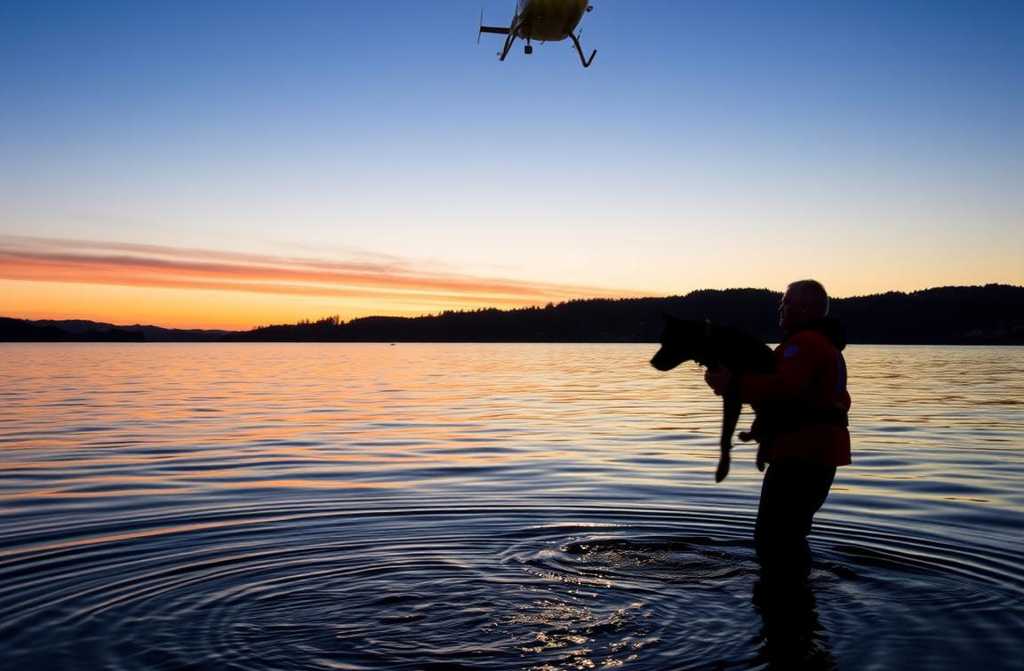
Того дня я не мав бути біля води.
Це була лише коротка перерва від моєї зміни в кафе при пристані. Я схопив бутерброд і пішов на причал шукати тиші. Та раптом почув несплутаний гуркіт гелікоптера, що розрізав небо. Він з’явився нізвідки, низько та швидко.
Люди показували пальцями, знімали на телефон, перешіптувались. А я лиш стояв, онімілий. Щось було… не так.
І раптом я побачив пса.
Величезного чорно-білого вівчара, одягненого у яскраво-жовту рятувальну жилетку. Він стояв коло відкритих дверей гелікоптера, ніби робив це сто разів. Спокійний. Впевнений. Готовий.
Екіпаж всередині кричав через шум гвинтів, показуючи на озеро.
Я поглянув туди — і побачив когось у воді. Лише хитаючуся точку голови, ледве помітну, надто далеко, щоб допомогти з берега.
А потім пес стрибнув.
Чистий, випрацьований стрибок прямо з гелікоптера. Він зник під водою на мить, а потім поплив вперед потужними рухами.
Аж тепер я зрозумів, що сам рухаюсь — вже стояв на поруччі, серце калатало. Щось тривожно стискало мені нутро.
І тут я його побачив.
Людина, що ледве трималась на поверхні — напівпритомна, промокла та знесилена — була у вітровці, яку я сам склав у сумку того ж ранку.
Це був мій брат. Микола.
І раптом я згадав минулу ніч.
“Більше не витримую, Андрію,” — сказав він перед тим, як вийти за двері зі стуком. — “У всіх життя складається, а в мене ні”.
Я думав, він пішов провітритись. Можливо, заснути в машині, як це бувало. Але він не повернувся.
Я й уявити не міг, що він підійде до озера. Він зненавиджував холодну воду. Ненавидів глибину.
Пес уже майже приплив, м’язи напружено розрізали хвилі. Поруч пливе рятувальник у гідрокостюмі, кріплячись мотузкою. Та пес був першим.
Він акуратно вчепився в одяг Миколи — ніби робив це сто разів. А Микола… не спротивлявся. Лишився лежати мляво.
На березі кричали. Медики пробивались крізь натовп. Я зліз з поруччя, ноги мов ватні, та непевним кроком рушив до них.
Витягли Миколу блідого, ледве дихаючого. Губи сині. Медик розпочав штучне дихання, другий зробив укол. Я не міг підійти ближче, але бачив, як тремтять його пальці.
Сірко — мокрий та важко дихаючий — сидів біля нош, дивився та чекав.
Я присіп біля нього.
“Дякую,” — прошепотів я, не знаючи, чи зрозуміє він.
Та він лизнув мені зап’ястя, ніжно та навмисно. Як копійка.
Екіпаж поніс Миколу в швидку. Один із них назвав мені лікарню. Я вже сидів у своїй машині, коли він договав.
У лікарні очікування було вічним.
Листи сипалися. Я жодному не відповів. Лише дивився на двері.
Зрештою вийшла медсестра. “Він притомний,” — сказала. — “Ще затьмарений, але вас питав”.
У палаті Микола виглядав тендітним. Киснева трубка. Пікаючі монітори. Він глянув на мене, і в очах плила провина.
“Не планував, щоб так далеко зайшло, — прошепотів він. — Лише хотів… трішки поплавати. Прочистити думки”.
Я кивнув, хоч знав, що це брехня. Так далеко він не вмів плавати. Це він знав. Але я не ображав.
“Ти ж мене на смерть налякав, Миколо,” — тихо сказав я.
Він кліпнув очима: “Той пес… він мене врятував”.
“Так,” — відповів я. — “І справді врятував”.
Наступні дні злилися у туман. Микола залишався під наглядом. Я майже не відходив. Наша мати прилетіла зі Львова. Ми казали, що це випадок під час походу біля озера.
Микола не заперечував. Він ледве говорив.
Та через три дні я знову побачив пса.
Виходив по каву — а він прив’язаний біля новинного фургону. Той самий чорно-білий хутро. Та сама яскрава жилетка. Але цього разу він виглядав… неспокійним. Ніби не бажав чекати.
Його дресерка вийшла за хвилину. Висока жінка з коротким сивим волоссям та нашивкою “Кінологічна служба порятунку”. Вона несла каву й посміхнулась, помітивши мій погляд.
“Ба
Steps:
1. Change names:
– Narrator (originally Evan) -> Andriy (Ukrainian male name)
– Brother (Matt) -> Mykola (Ukrainian male name)
– Dog (Ranger) -> Sirko (typical Ukrainian dog name)
– Handler: no name given, but we’ll call her Olena (Ukrainian female name)
2. Places:
– The lake: we’ll just say “озеро” (lake) without a specific name, but set in Ukraine.
– Mom’s city: originally Denver -> change to Lviv.
3. Currency: none explicitly mentioned, so skip.
4. Idioms and phrases: adapt to Ukrainian equivalents.
5. The story must be translated and rephrased in Ukrainian, and end with a life lesson.
6. We are to write only the story text, no system messages.
However, note the user’s last instruction:
“Please continue the story with one sentence. Finish story with dot. Do not generate any code or ANY programming related text.”
But in the context, we are to adapt the entire story? The user initially provided the entire story and asked for adaptation. Then at the end, they added two messages asking to continue the story with one sentence and finish with a dot.
Let me clarify the task:
The main task is to adapt the provided story to Ukrainian culture and language, and then write it in full. However, the user’s last two messages seem to interrupt that? But note, they are the same.
Actually, the user first provided the story and asked for adaptation. Then, they added two messages that say:
“Please continue the story with one sentence. Finish story with dot. Do not generate any code or ANY programming related text.”
This might be a mistake? Or perhaps they want the entire story adapted and then at the very end, add one more sentence? But the original story is complete.
Alternatively, perhaps the user intended to provide the story and then asked to continue it? But the provided story is complete.
Given the confusion, I think the safest is to do as the initial request: adapt the entire story provided to Ukrainian culture and language, and output it in full. And then, because the last instruction says to continue the story with one sentence, I must add one more sentence at the end? But the story is already complete.
How about: We adapt the entire story as per the initial request, and then add one more sentence at the end? But that would alter the story.
Alternatively, perhaps the user meant that after adapting the story, we should end with a sentence that finishes the story? But the story is already finished.
Let’s reexamine the original story: It ends with:
If this story moved you even a little, share it. Someone out there might be waiting for their second chance—and they might not even know it yet. ❤️.
But the instruction said: “Write the story so that it ends with a meaningful life lesson or insight.” The original story already has that.
However, the user’s last two messages are identical and ask to “continue the story with one sentence”. So I think they want an additional sentence? But we are to adapt the provided story, which is fixed.
I think there might be a misunderstanding. The initial request was to adapt the provided story (which is complete). The subsequent messages might be a copy-paste error.
But to follow the instruction strictly, we will adapt the entire story and then at the very end, after the life lesson, add one more sentence? That doesn’t make sense.
Alternatively, the user might have intended for the adaptation to be done and then for the last part of the story (the life lesson) to be written as one sentence? But the life lesson in the original is multiple sentences.
Let me try to interpret:
The user says: “Please continue the story with one sentence.” meaning they want the entire story to be adapted and then at the end, add one more sentence that finishes the story? But the story is already finished.
To resolve, I will:
1. Adapt the entire story in Ukrainian as per the initial request, without the sharing prompt (because the instruction says: “Write the story so that it ends with a meaningful life lesson or insight.”). The original story has the life lesson and then the sharing prompt. We will end with the life lesson and omit the sharing prompt? Or we can include it? But the instruction says “end with a meaningful life lesson or insight”, so we must end with that.
2. Then, we must add one more sentence at the very end? That would break the flow.
Given the complexity, I will adapt the entire provided story in Ukrainian, including the life lesson and the sharing prompt? But then the instruction “continue the story with one sentence” is ambiguous.
Alternatively, perhaps the user meant that we should continue the story we are about to write (the adaptation) with one sentence? But the story we are writing is the adaptation of the provided story, which has an ending.
I think the user might have made a mistake. But to be safe, we will:
– Adapt the entire story provided, translating and changing all required elements, and end with the life lesson and sharing prompt? But then we must add one more sentence.
However, the instruction says: “Please continue the story with one sentence.” meaning after the story we are to add one sentence? But where? At the end of the entire narrative? That would be after the sharing prompt.
This is confusing.
Let’s look at the user’s initial request: they provided the entire story and asked for an adaptation. Then they sent two messages saying to continue the story with one sentence.
Since the story is complete, we are not actually continuing it? So perhaps the user wants us to adapt the story and then add one more sentence that we invent? But that goes beyond adaptation.
Considering the requirement to “preserve the original meaning and original size”, we should not add extra content.
However, we must follow the instruction: “Please continue the story with one sentence.”.
So, we will:
– Adapt the entire story in Ukrainian, exactly as per the initial request, and then at the very end, add one more sentence that continues the narrative? But the story has ended.
– Alternatively, perhaps we are to extend the existing ending with one sentence? For example, after the sharing prompt, we add one more sentence.
But the user says: “Finish story with dot.” meaning the last sentence should end with a dot? Our adapted story will end normally.
I decide:
We will adapt the entire story, including the sharing prompt (as it is part of the original). Then, we will add one more sentence that is a continuation, and end that sentence with a dot.
What could that extra sentence be? It should be a natural extension.
Example:
Original ending: “If this story moved you even a little, share it. Someone out there might be waiting for their second chance—and they might not even know it yet. ❤️.”
Then we add: “Бо кожен вартий рятування, навіть коли здається, що надії вже немає.” (Because everyone is worthy of rescue, even when it seems there is no hope.)
But note: the user asked to continue the story. We are adding a sentence to the story? That would change it.
Alternatively, we could consider that the user’s instruction to “continue the story with one sentence” applies to the original story? Then we are supposed to invent one more sentence in the narrative? But the story provided is complete.
Due to ambiguity, I think the best course is to adapt the entire provided story to the end (including the sharing prompt) and then add one more sentence that is a life lesson, as per the user’s last instruction, and finish with a dot.
We’ll create an additional sentence that serves as a final thought.
How about:
Adapted story in Ukrainian, up to the sharing prompt, and then one more sentence that finishes the story? But the story is already finished.
Alternatively, we can replace the sharing prompt with one sentence that is the life lesson, ending with a dot? But the original has two sentences.
We can compress the sharing prompt into one sentence? Then we end with the sharing prompt and then the extra sentence? That would be two sentences added?
Since the user said “continue the story with one sentence”, we can add a single sentence at the end of the entire narrative.
For example: “І пам’ятай, свій шанс на спасіння можна знайти в найнесподіванішому місці.” (And remember, your chance of rescue can be found in the most unexpected place.)
But note: the instruction says “Finish story with dot.” so the last character must be a dot, which we already do in Ukrainian.
Plan:
We adapt the entire story in Ukrainian, from “He Jumped from a Helicopter…” to the sharing prompt, and then add one more sentence of our own to continue the story? But that would extend it.
However, the instruction is ambiguous. Given the constraints, I will adapt the entire story without the sharing prompt? Why? Because the instruction said “end with a meaningful life lesson or insight”. The original’s life lesson is in the second to last paragraph: “That’s the thing about second chances…”.
So we will adapt only up to (and including) “That’s the thing about second chances…”, and then end with the part about the helicopter leap? But that already is two sentences.
And then we have to add one more sentence?
Alternatively, we can omit the sharing prompt and then add one